

Using lactate and Norwegian method in hybrid training
Webinar with Fabian Eisenlauer and Dr David Lipman

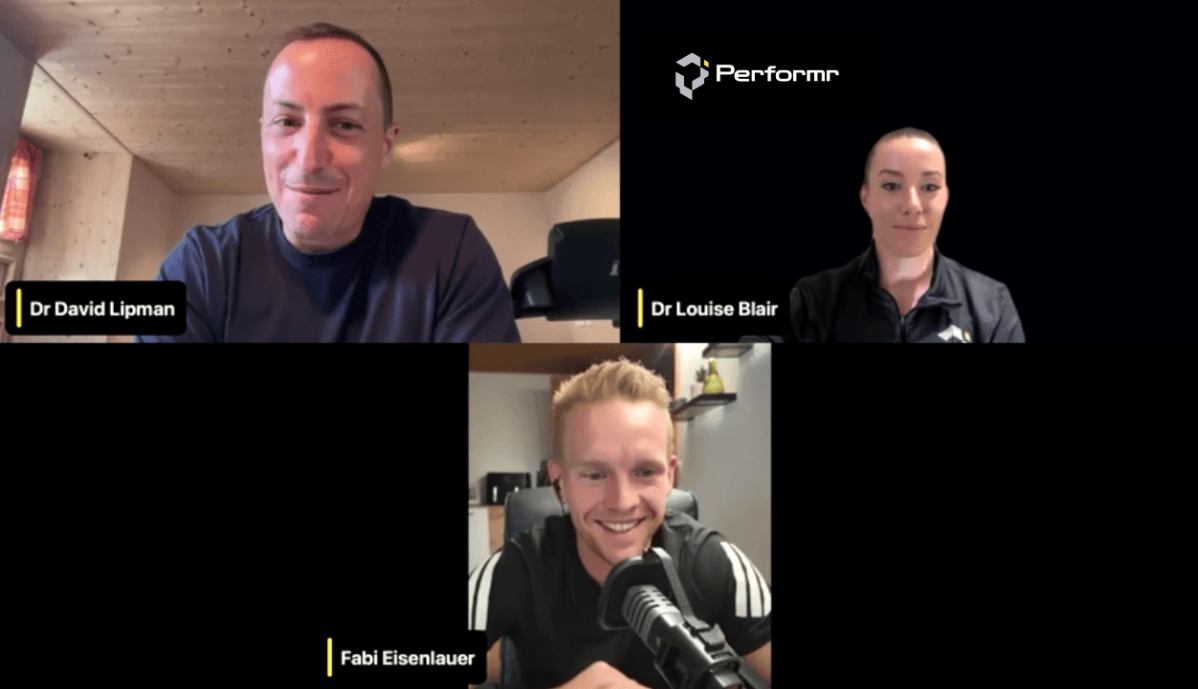
This article draws on our recent webinar, "Train Smarter, Race Harder," with HYROX World Champion Fabian Eisenlauer and performance specialist Dr. David Lipman, hosted by Dr. Louise Blair.
You can watch the full conversation here: Watch the recording →. What follows are the key ideas and what they mean for how you train.
What a World Champion's data taught us about training with the full picture
Lactate testing has a reputation problem at both extremes. Some athletes treat the number as the whole game — get it down, win. Others, reacting to that, wave it away as overcomplicated. In a recent conversation between HYROX World Champion Fabian Eisenlauer and performance specialist Dr. David Lipman, a more useful truth emerged, and it's the one that matters most to how you actually train: lactate is one of the most powerful tools an athlete has — precisely because it's read in context, alongside everything else.
Used well, it's not a scoreboard. It's a lens. And the clearer and more continuous that lens, the more it can optimise.
Foundations first — then the tools sharpen everything
Lactate testing, double-threshold sessions, station-specific profiling: these earn their power once the basics are in place. Consistency, training history, and genuine enjoyment of the work come first.
But this isn't an argument for delaying the tools — it's an argument for what they unlock. Once the foundations are there, lactate data is what turns solid training into precise training. It's the difference between knowing you trained hard and knowing exactly how hard, where, and whether it's sustainable. The foundations make the data meaningful; the data makes the foundations pay off faster.
HYROX is not "just running"
Performance depends on both the running and the station demands and on how fatigue from the stations bleeds into your runs, and vice versa. The two constantly interfere with each other.
That interaction is exactly the kind of thing a single lab test can't capture but continuous data can. Race duration matters too: a 50-minute HYROX effort is metabolically different from a 90-minute one. The more of your real training you can actually see, the better you can match your preparation to your true race demands rather than the label on the event.
Lactate as a control system
Here's the heart of it. Lactate's value is intensity control — a reliable read on your internal load, so you know whether a session is truly sitting where you intended it, rather than where you assume. That's information heart rate and pace can't give you on their own.
It works best as part of a dashboard, not a single dial. Low lactate is a great sign when pace, power, and repeatability are holding — and a warning sign when they're not. Read alongside your performance markers, lactate tells you whether you're building fitness or digging a hole. That's not a reason to trust the number less. It's a reason to want more of it, in context, continuously.
The fuelling piece — where context is everything
This is the clearest case for reading lactate alongside other signals. Under-fuelling can suppress lactate readings, making a session look cleaner than it is while performance quietly suffers underneath.
Fabian spoke openly about how under-fuelling and weight-focused thinking earlier in his career contributed to injury and poor recovery — consistent with what can now be recognised as low energy availability, or RED-S. Increasing his carbohydrate intake improved his recovery, sleep, and performance. The lesson isn't that lactate misleads you — it's that lactate, read against fuelling, recovery, and output, tells a story no single metric could. Continuous data across those signals is how you catch the trap before it costs you.
How the week fits together
Fabian's structure is refreshingly clear. Hard work gets clustered — threshold sessions, lifting, tougher station work on the same days — so fatigue is concentrated, not smeared. Easy days stay genuinely easy, often below 70% of max heart rate.
Threshold work sits at the centre: repeated sessions to accumulate quality volume while staying just below the point where the recovery cost climbs too high. Knowing exactly where that point is, session to session, is where lactate data earns its keep. Double-threshold is optional — with only one session a day, the same principle applies: one controlled threshold effort, guided by real data, then proper recovery. And consistency beats novelty: similar sessions, week after week, with small, informed adjustments.
Testing beyond the run
Lactate testing doesn't have to stop at running. Fabian described step-style testing on stations like burpees, rowing, and sled work to estimate thresholds for those movements too.
That feeds profiling — short and longer efforts plus station benchmarks — to reveal whether an athlete needs more threshold development, more VO2 max work, or more station strength and economy. For elite athletes especially, Fabian sees real upside in movement economy at the stations, not just aerobic fitness. The more data points across more movements, the sharper those priorities become.
Built for the individual
There's no universal "correct" lactate number — thresholds and useful zones vary by athlete, which is exactly why individual, continuous data beats generic formulas. Altitude and heat may help some, though HYROX-specific constraints make them harder to apply.
The through-line is simple: lactate is one of the most useful signals an athlete can train with, and it gets more useful the more of it you can see, and the more context you can read it in. Fabian is already doing this by hand, one finger-prick at a time — capturing snapshots of a picture that's always moving.
That's what continuous lactate monitoring is built to change: not to make the number matter less, but to give you the full, uninterrupted signal — read alongside everything else — so you can optimise with confidence instead of guessing between data points.