

The Overtraining Early Warning System
Real-Time Biomarker Data Explained
Overtraining can seemingly creep up on athletes and can be crippling to their performance, not to mention require a long period of recovery. This is particularly problematic given the relationship between injury free time and success in the sporting arena.
One of the biggest challenges athletes face is balancing training load and recovery capacity, because ultimately the load the athlete is able to adapt to is key and anything beyond this is problematic from an injury risk perspective. Unfortunately it can be hard to be sure of how much load an athlete can tolerate, particularly because other stressors reduce training load tolerance. Similarly, the goal, from time to time, is to exceed this normal capacity, overreaching in the hope of super compensating - coming back stronger.
As such, athletes can find themselves in a tricky situation of trying to maximise training, but unsure if they are doing too much, risking overtraining. When it comes to high performance, the answer to this is, unfortunately, not to keep a safe margin of error. Thus the search for tools to monitor overtraining has been ongoing, and thankfully the use of continuous biomarkers is now available and showing promise in this space.
What is Overtraining?
Overtraining syndrome represents the end stage of a continuum of normal training adaptation, through functional overreaching, non-functional overreaching and finally overtraining syndrome.
The delineation between the parts of this spectrum can be difficult at times, but in essence the difference is really duration related as is outlined in the below diagram from the Joint Consensus Statement of the European College of Sport Science and the American College of Sports Medicine on Prevention, Diagnosis, and Treatment of the Overtraining Syndrome.
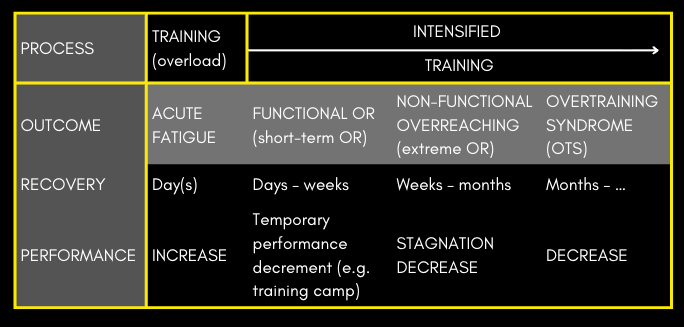
Crucially, the position stand makes it clear that overtraining syndrome represents the sum of multiple life stressors, rather than training alone. These can include environmental stressors (like heat, cold or altitude), training, reduced energy availability (more on this later), work or study related stress and interpersonal relationship stressors.
What Are the Signs of Overtraining?
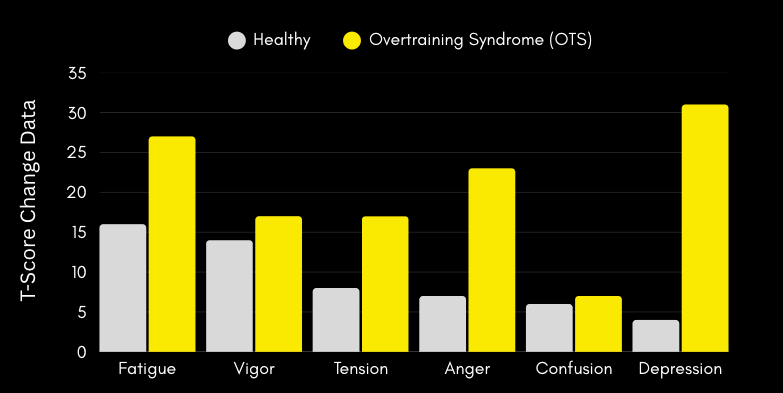
Signs and symptoms of overtraining are quite varied and individual, perhaps reflecting the multifactorial nature of the syndrome. This may also be part of why identifying overtraining can be quite difficult, particularly for the individual experiencing it, perhaps highlighting the value of a good support staff and performance team.
That said, classically, mood changes are described when discussing signs of overtraining, as detailed below from the Joint Consensus Statement of the European College of Sport Science and the American College of Sports Medicine on Prevention, Diagnosis, and Treatment of the Overtraining Syndrome.
Similarly sleep disturbances are often reported, though the direction of this relationship is difficult to determine given sleep’s role in recovery and stress management.
Unsurprisingly, there is a significant appetite for biomarkers of overtraining syndrome, given it’s difficult to pinpoint nature and consequences.
How Can Performr Help Detect Overtraining?
Given the somewhat variable nature of what is observed from a biomarker standpoint when it comes to overtraining it may seem like a fool’s errand to even bother trying to use biomarkers to detect overtraining. Quite the contrary though, these conflicting biomarker observations more likely reflect the heterogeneous nature of the underlying aetiology of overtraining.
As mentioned above, overtraining is a stress balance problem, with all stressors contributing to varying degrees in any one situation. This is further supported by the common pathways seen between overtraining and underfueling. Again, this may sound like a situation too complex to use biomarkers for, and this is likely true if using more traditional blood testing but we are now in the era of continuous biomarkers.
The continuous nature of the data gleaned from Performr is the key to detecting early warning signs of overtraining.
Significant deviations from baseline and expectation are key, consider these as canaries in the metaphorical coal mine. This may manifest as suppression of glucose or lactate at rest or during training (especially during high intensity training, with lactate levels being blunted at high intensity). It may also manifest as much more variable glucose post meal, likely as a result of a level of mitochondrial dysfunction. All of these have been reported in cases of overtraining or similar in the literature.
What Does this Look Like in Practice?
Using any continuous biomarker data requires a period of ‘baselining’ - which allows the user to understand what their ‘normal’ is. This phase is somewhere in the 2-8 week range, depending on the context of the individual. In this phase, there is no intervention, just observation to understand normal and normal variation, during training and outside of it. This is ideally done in the late offseason and/or early pre-season (aka base phase).
From this point, deviations can be observed from ‘normal’ when extra stressors are applied, for instance altitude camps, underfueling (intentional or unintentional), exam stress and the list goes on. When there is a deviation from normal, this is the aforementioned ‘canary in the coal mine’ to alert athletes, coaches and support staff to the situation.
Crucially, this may not mean cessation of training, or even reduction of training load. Remember, the issue is stress balance. So extra emphasis on recovery, nutrition or sleep may be the answer. Similarly, if occurring as a result of increased training load (or indeed external stressors like heat or altitude), this overreaching may be the goal and the recovery phase with supercompensation is on the horizon and planned already. *A quick note; using a change from baseline as a goal of measuring achievement of overreaching is ill-advised.
Take Home Messages
Overtraining is a spectrum from normal adaptation through overreaching and into overtraining
Overtraining represents a stress imbalance and all stressors play a role in its development
Research on biomarkers to diagnose overtraining has been challenging but continuous biomarker data has the potential to change this
Deviations from normal behaviour of glucose and lactate are a potential warning sign for development of overtraining syndrome
To stay up to date with articles and news from Performr sign up here.
Written by Dr David Lipman
References:
Raysmith BP, Drew MK. Performance success or failure is influenced by weeks lost to injury and illness in elite Australian track and field athletes: A 5-year prospective study. J Sci Med Sport. 2016 Oct;19(10):778-83. doi: 10.1016/j.jsams.2015.12.515. Epub 2016 Jan 7. PMID: 26839047.
Prevention, Diagnosis, and Treatment of the Overtraining Syndrome: Joint Consensus Statement of the European College of Sport Science and the American College of Sports Medicine. Medicine & Science in Sports & Exercise 45(1):p 186-205, January 2013. | DOI: 10.1249/MSS.0b013e318279a10a
Stellingwerff T, Heikura IA, Meeusen R, Bermon S, Seiler S, Mountjoy ML, Burke LM. Overtraining Syndrome (OTS) and Relative Energy Deficiency in Sport (RED-S): Shared Pathways, Symptoms and Complexities. Sports Med. 2021 Nov;51(11):2251-2280. doi: 10.1007/s40279-021-01491-0. Epub 2021 Jun 28. PMID: 34181189.
Coates, Alexandra & Thompson, Kyle & Grigore, Monica & Baker, Ryleigh & Pignanelli, Chris & Robertson, Alexa & Frangos, Sara & Cheung, Christian & Burr, Jamie. (2023). Overreached endurance athletes demonstrate alterations in exercising carbohydrate utilization applicable to training monitoring. 10.51224/SRXIV.321. https://sportrxiv.org/index.php/server/preprint/view/321
Coates AM, Thompson KMA, Grigore MM, Baker RE, Pignanelli C, Robertson AA, Frangos SM, Cheung CP, Burr JF. Altered carbohydrate oxidation during exercise in overreached endurance athletes is applicable to training monitoring with continuous glucose monitors. Scand J Med Sci Sports. 2024 Jan;34(1):e14551. doi: 10.1111/sms.14551. Epub 2023 Dec 13. PMID: 38093477.
Flockhart M, Nilsson LC, Tais S, Ekblom B, Apró W, Larsen FJ. Excessive exercise training causes mitochondrial functional impairment and decreases glucose tolerance in healthy volunteers. Cell Metab. 2021 May 4;33(5):957-970.e6. doi: 10.1016/j.cmet.2021.02.017. Epub 2021 Mar 18. PMID: 33740420.
Flockhart M, Larsen FJ. Continuous Glucose Monitoring in Endurance Athletes: Interpretation and Relevance of Measurements for Improving Performance and Health. Sports Med. 2024 Feb;54(2):247-255. doi: 10.1007/s40279-023-01910-4. Epub 2023 Sep 2. PMID: 37658967; PMCID: PMC10933193.
Sygo J, Coates AM, Sesbreno E, Mountjoy ML, Burr JF. Prevalence of Indicators of Low Energy Availability in Elite Female Sprinters. Int J Sport Nutr Exerc Metab. 2018 Sep 1;28(5):490-496. doi: 10.1123/ijsnem.2017-0397. Epub 2018 Aug 17. PMID: 29757049.
Alicia M. Ranahan, Christopher Pignanelli, Kyle M.A. Thompson, Jamie F. Burr, and Alexandra M. Coates. 2025. Alterations in glycemic control and glucose tolerance following overtraining in endurance athletes. Applied Physiology, Nutrition, and Metabolism. 50: 1-10. https://doi.org/10.1139/apnm-2025-0278