

Your Body on the Move
How Travel Quietly Rewrites Your Biomarkers
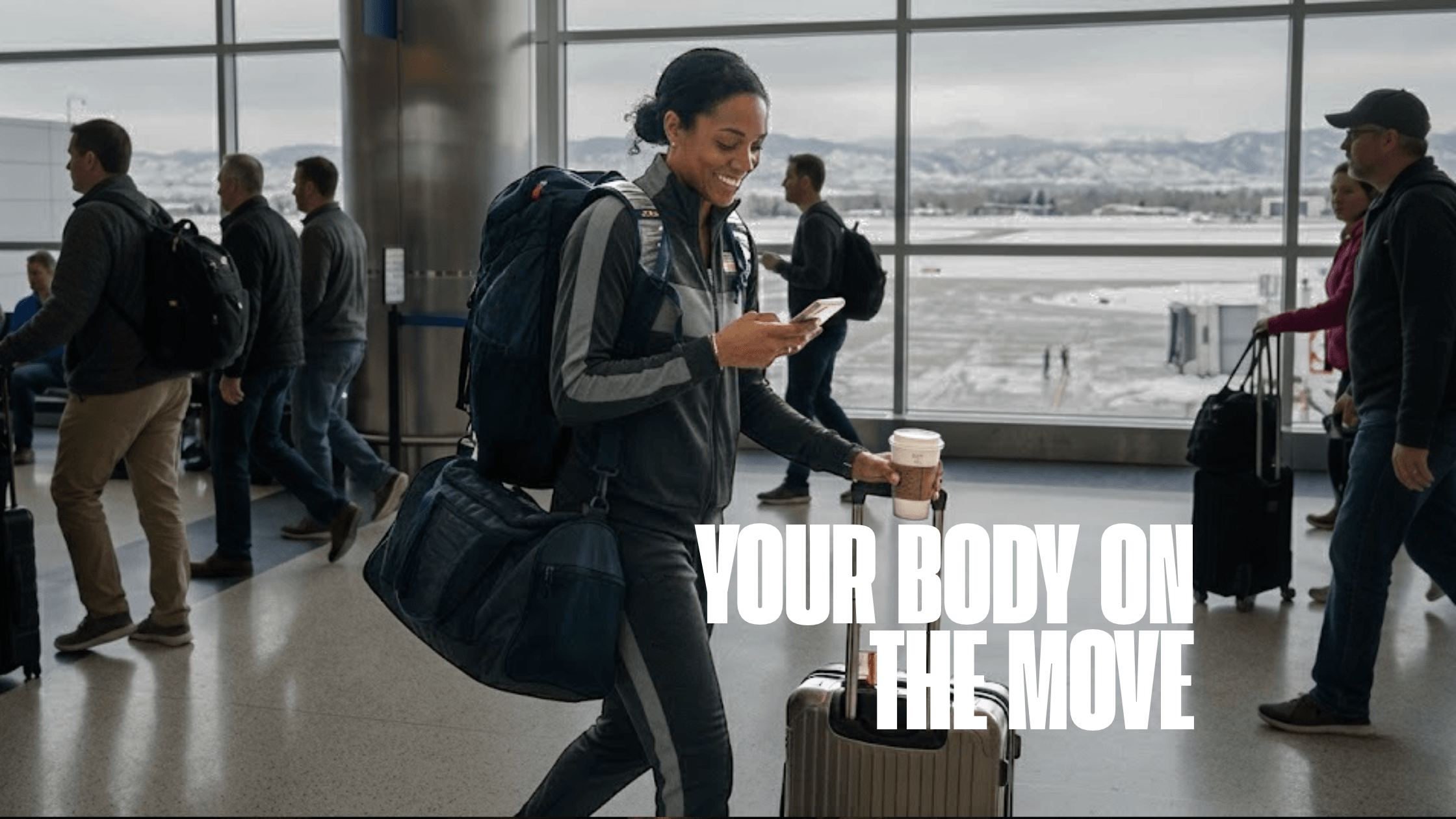
Race weekends abroad, work trips, holidays between training blocks: for most athletes, travel is part of the season. We plan the kit, the bookings and the pre-race meal, but rarely the fact that a day of travel can shift your physiology as much as a hard session. If you've ever landed, looked at your data and wondered why everything looks off, you're not imagining it.
The flight: thin, dry air
Commercial aircraft cabins are pressurised, but not to sea level. At cruising altitude, cabin pressure is typically equivalent to around 1,800 to 2,400 metres above sea level, about the height of a mid-sized Alpine resort [1]. At that pressure, less oxygen gets into the blood. In one study of 84 passengers, average blood oxygen saturation fell from 97% on the ground to 93% at cruising altitude [3]. When healthy volunteers breathed a similar low-oxygen mix in the lab, their breathing rate rose [4]. It's a small but real physiological load that lasts the whole flight.
The air is also extremely dry. Cabin humidity typically sits around 10 to 20 percent, compared with over 30 percent in most homes [1, 2]. That, in combination with drinking less to avoid the aisle and having caffeine and alcohol, can cause dehydration and running low on fluid can make glucose read higher and push heart rate up.
Sitting still: glucose with nowhere to go
Skeletal muscle is the body's main destination for glucose after a meal, accounting for around 80 percent of insulin-stimulated glucose uptake [5]. Contracting muscle can also pull glucose in through transporters called GLUT4, by a route that works separately from insulin [6]. When muscles sit idle for hours, that movement-driven route goes quiet.
The result is that the same meal can produce a higher, longer glucose curve when you're stuck in a seat. In a controlled trial of 70 healthy, normal-weight adults, short walks of under two minutes every 30 minutes lowered glucose and insulin after meals compared with sitting for nine hours, and worked better than a single 30-minute walk [7]. Long-haul travel is the extreme version of the problem, with hours of stillness often combined with carbohydrate-heavy airport and in-flight food at unusual times.
Crossing time zones: a clock out of sync
Your body runs on a master clock in the brain, called the suprachiasmatic nucleus, which is set mainly by light. It works alongside clocks in other organs, such as the liver and pancreas, that help time how you handle food [8, 11]. In animal studies, changing meal times shifted the liver's clock while the brain's clock stayed locked to light [8, 9].
Fly across several time zones and two problems appear. First, your body clock is out of step with local time, which is the main cause of jet lag [17]. Second, the clocks can drift out of step with each other: the brain follows the new daylight, while organ clocks respond to new meal times at their own pace [8, 9]. Scientists call this internal desynchrony.
The effects show up in biomarkers:
Cortisol: normally rises sharply over the first 30 to 45 minutes after waking [10]. Like other rhythms driven by the body clock, it takes time to realign with local time after a long trip [16, 17].
Glucose control: glucose tolerance is naturally better in the morning than in the evening [12]. In controlled lab studies, eating and sleeping out of sync with the body clock raised glucose even though the body produced more insulin [11, 12]. In one study, three of eight healthy participants showed post-meal glucose in the prediabetic range when misaligned, an effect the authors linked to jet lag [11].
Performance: sports performance varies with time of day [13], and many measures peak in the afternoon or evening, in line with rising body temperature [14]. After travel, that peak lands at the wrong local time until your clock adjusts.
Adjustment takes time, roughly a day per time zone as a rule of thumb, and travelling east is usually harder [15]. That's because the body clock naturally runs slightly longer than 24 hours, around 24 hours and 11 minutes on average [16], so lengthening your day by flying west is easier than shortening it by flying east [15].
Sleep: the multiplier
Travel almost always disrupts sleep, and sleep loss amplifies everything above. A single night of four hours' sleep reduced insulin sensitivity in healthy adults the next day [18]. Two nights of short sleep lowered the fullness hormone leptin, raised the hunger hormone ghrelin, and increased appetite [19]. Sleep loss can also unsettle the autonomic nervous system, which regulates heart rate and heart rate variability [20], and it makes exercise feel harder [21].
What it means for training
Put together, the first few days after a long trip are a noisy window. Sessions may feel harder [21], recovery markers can look worse, and glucose can behave less predictably [11, 18]. None of this means fitness has disappeared. Your body is still re-aligning, so the smartest move is to ease in rather than push through.
Travelling smarter
The science points to a few habits that make a real difference:
Hydrate steadily throughout the flight, and go easy on caffeine and alcohol.
Move every 30 minutes or so where you can: walk the aisle, stand, or do calf raises at your seat [7].
Use light strategically: after flying east, seek bright morning light; after flying west, seek evening light. After crossing more than eight time zones, avoid bright light at the wrong times for the first couple of days [22].
Eat on local time from day one, as meal timing helps reset the body's organ clocks [8, 9].
Use caffeine in the local morning and avoid it after midday, as it can disrupt sleep [22].
Keep the first sessions light, and refer to your data to help you see when you're back to baseline.
Want to stay on top of posts like this — and be among the first to see what continuous, multi-marker monitoring can reveal? Join the Performr waitlist to keep up with the latest insights, product news and training science from the team.
References 1. World Health Organization (2005). International Travel and Health, Chapter 2: Travel by air – health considerations. WHO chapter PDF; reprinted in Canada Communicable Disease Report 32(01), 2006. 2. Aerospace Medical Association (2014). Medical Guidelines for Airline Travel: Stresses of Flight. 3. Humphreys S, Deyermond R, Bali I, Stevenson M, Fee JPH (2005). The effect of high altitude commercial air travel on oxygen saturation. Anaesthesia 60(5): 458–460. 4. Hobkirk JP et al. (2013). Effects of reducing inspired oxygen concentration for one hour in patients with chronic heart failure: implications for air travel. European Journal of Heart Failure. 5. DeFronzo RA, Tripathy D (2009). Skeletal muscle insulin resistance is the primary defect in type 2 diabetes. Diabetes Care 32(Suppl 2): S157–S163. 6. Lund S, Holman GD, Schmitz O, Pedersen O (1995). Contraction stimulates translocation of glucose transporter GLUT4 in skeletal muscle through a mechanism distinct from that of insulin. PNAS 92(13): 5817–5821. 7. Peddie MC, Bone JL, Rehrer NJ, Skeaff CM, Gray AR, Perry TL (2013). Breaking prolonged sitting reduces postprandial glycemia in healthy, normal-weight adults: a randomized crossover trial. American Journal of Clinical Nutrition 98(2): 358–366. 8. Damiola F et al. (2000). Restricted feeding uncouples circadian oscillators in peripheral tissues from the central pacemaker in the suprachiasmatic nucleus. Genes & Development 14(23): 2950–2961. 9. Stokkan KA, Yamazaki S, Tei H, Sakaki Y, Menaker M (2001). Entrainment of the circadian clock in the liver by feeding. Science 291(5503): 490–493. 10. Stalder T et al. (2016). Assessment of the cortisol awakening response: expert consensus guidelines. Psychoneuroendocrinology 63: 414–432. 11. Scheer FAJL, Hilton MF, Mantzoros CS, Shea SA (2009). Adverse metabolic and cardiovascular consequences of circadian misalignment. PNAS 106(11): 4453–4458. 12. Morris CJ et al. (2015). Endogenous circadian system and circadian misalignment impact glucose tolerance via separate mechanisms in humans. PNAS 112(17): E2225–E2234. 13. Drust B, Waterhouse J, Atkinson G, Edwards B, Reilly T (2005). Circadian rhythms in sports performance – an update. Chronobiology International 22(1): 21–44. 14. The circadian clock and human athletic performance (2017). University Thought – Publication in Natural Sciences 7(1). 15. The Sleep Charity. Jet lag. 16. Czeisler CA et al. (1999). Stability, precision, and near-24-hour period of the human circadian pacemaker. Science 284(5423): 2177–2181. 17. Waterhouse J, Reilly T, Atkinson G, Edwards B (2007). Jet lag: trends and coping strategies. The Lancet 369(9567): 1117–1129. 18. Donga E et al. (2010). A single night of partial sleep deprivation induces insulin resistance in multiple metabolic pathways in healthy subjects. Journal of Clinical Endocrinology & Metabolism 95(6): 2963–2968. 19. Spiegel K, Tasali E, Penev P, Van Cauter E (2004). Sleep curtailment in healthy young men is associated with decreased leptin levels, elevated ghrelin levels, and increased hunger and appetite. Annals of Internal Medicine 141(11): 846–850. 20. Fullagar HHK et al. (2015). Sleep and athletic performance: the effects of sleep loss on exercise performance, and physiological and cognitive responses to exercise. Sports Medicine 45(2): 161–186. 21. Kong Y, Yu B, Guan G, Wang Y, He H (2025). Effects of sleep deprivation on sports performance and perceived exertion in athletes and non-athletes: a systematic review and meta-analysis. Frontiers in Physiology 16: 1544286. 22. Sack RL (2010). Jet lag. New England Journal of Medicine 362(5): 440–447.