

Why One Biomarker Isn't the Whole Story
Why multianalyte monitoring is needed for the full picture
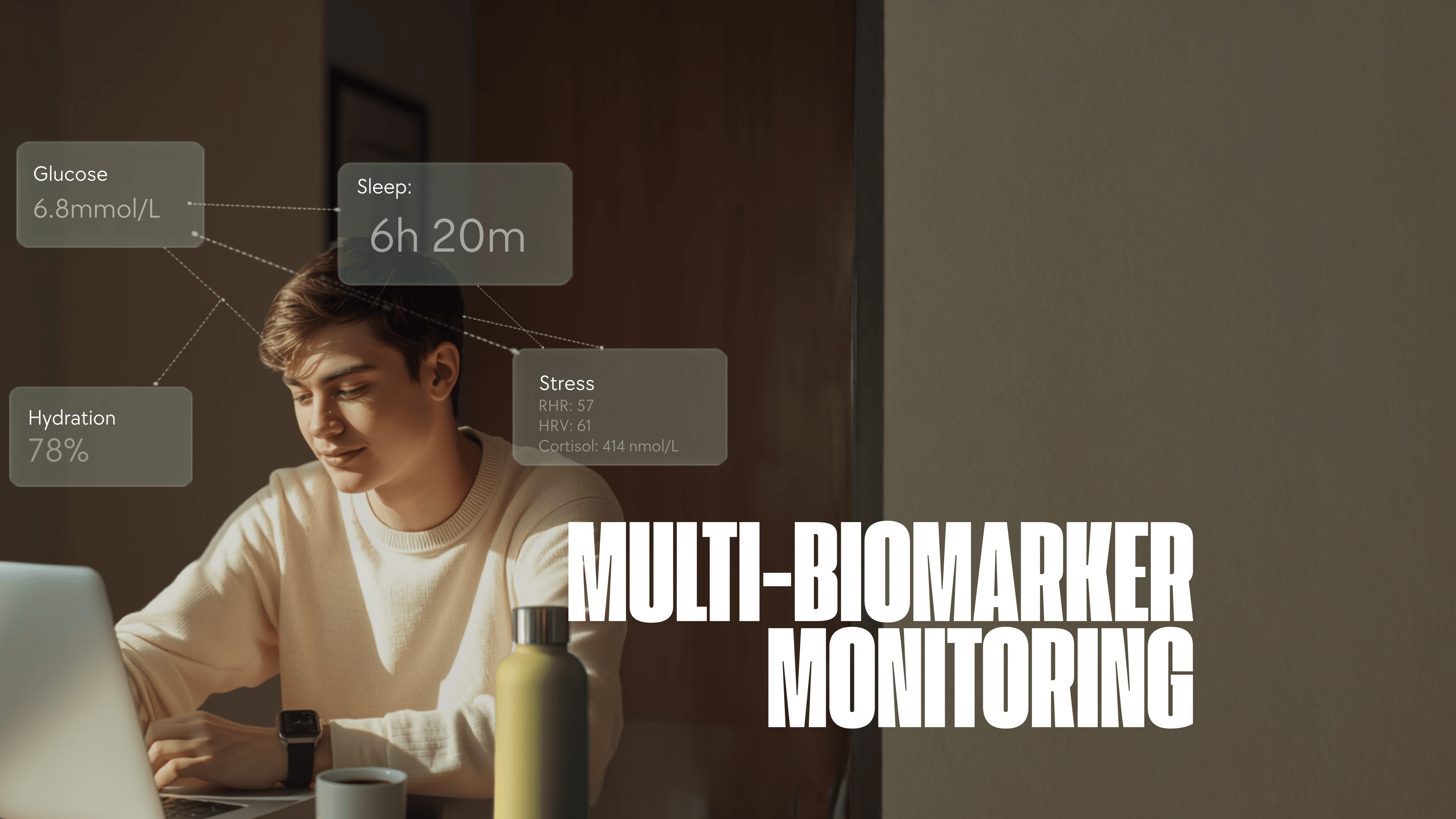
If you've ever worn a fitness tracker or a continuous glucose monitor, you've felt the appeal: a single number that tells you how your body is doing right now. It's satisfyingly simple. But your body isn't simple, and that single number can quietly mislead you.
Take glucose, which is getting a lot of traction on social media at the moment. A glucose reading tells you how much sugar is in your blood at a moment in time. What it doesn't tell you is why. Did it spike so high just because of the bagel you ate, or because you also slept badly, skipped your run, or walked into a stressful meeting? Glucose alone can't distinguish between those stories, yet they call for completely different responses.
The same number, different meanings
Your biomarkers are deeply interconnected, so any one of them only makes sense in context.
Consider stress. When you're under pressure, your body releases cortisol, a hormone that pushes your liver to dump more glucose into your blood, getting you ready to act. So a glucose spike during a tense afternoon might have nothing to do with food at all. If you're only watching glucose, you might cut carbs when the real lever is your sleep, your workload, or your recovery.
Or consider hydration. When you're even mildly dehydrated, the water in your blood drops, which concentrates everything dissolved in it, including glucose. The reading climbs, but you haven't actually eaten more sugar; your blood is just more concentrated. Drink some water and the number drifts back down. Without a hydration signal alongside it, you'd be chasing a problem that doesn't exist.
The pattern is clear: a single biomarker is a word, but health is a sentence. You need several words to read the meaning.
Why multi-analyte monitoring matters
Measuring several signals at once, glucose and cortisol and hydration, and ideally more, turns isolated data points into a coherent picture. Instead of "your glucose is high," you get "your glucose is high, your cortisol is elevated, and you're slightly dehydrated," which points you toward rest and water rather than guilt about lunch.
This context does a few important things:
It reduces false alarms. A reading that looks alarming on its own often becomes unremarkable once you see what's driving it. Multi-analyte data filters signal from noise.
It reveals root causes. Patterns emerge across markers that you'd never spot in one alone, like discovering that your worst glucose days are actually your most stressful, poorly-slept ones.
It personalises the response. Two people with identical glucose readings might need opposite advice. Context is what makes guidance actually fit you.
The bigger shift
Healthcare has historically measured things one at a time, partly because the technology made it hard to do otherwise. But the body never operates one variable at a time. Stress, sleep, hydration, nutrition, and metabolism are all in constant conversation. The next generation of health tools, from advanced wearables to multi-analyte sensors, is finally catching up to that reality.
The goal isn't more numbers for their own sake. It's understanding. It's context. A glucose monitor can tell you something happened. Multi-analyte monitoring can start to tell you why, and what to do about it.
So the next time a single reading surprises you, resist the urge to react to it in isolation. Ask what else was going on: Were you stressed? Tired? Thirsty? Your body was probably telling you a fuller story all along, you just needed more than one number to hear it.