

Putting the Performr Band to the Test
Comfort and Clean Signals in the Real World
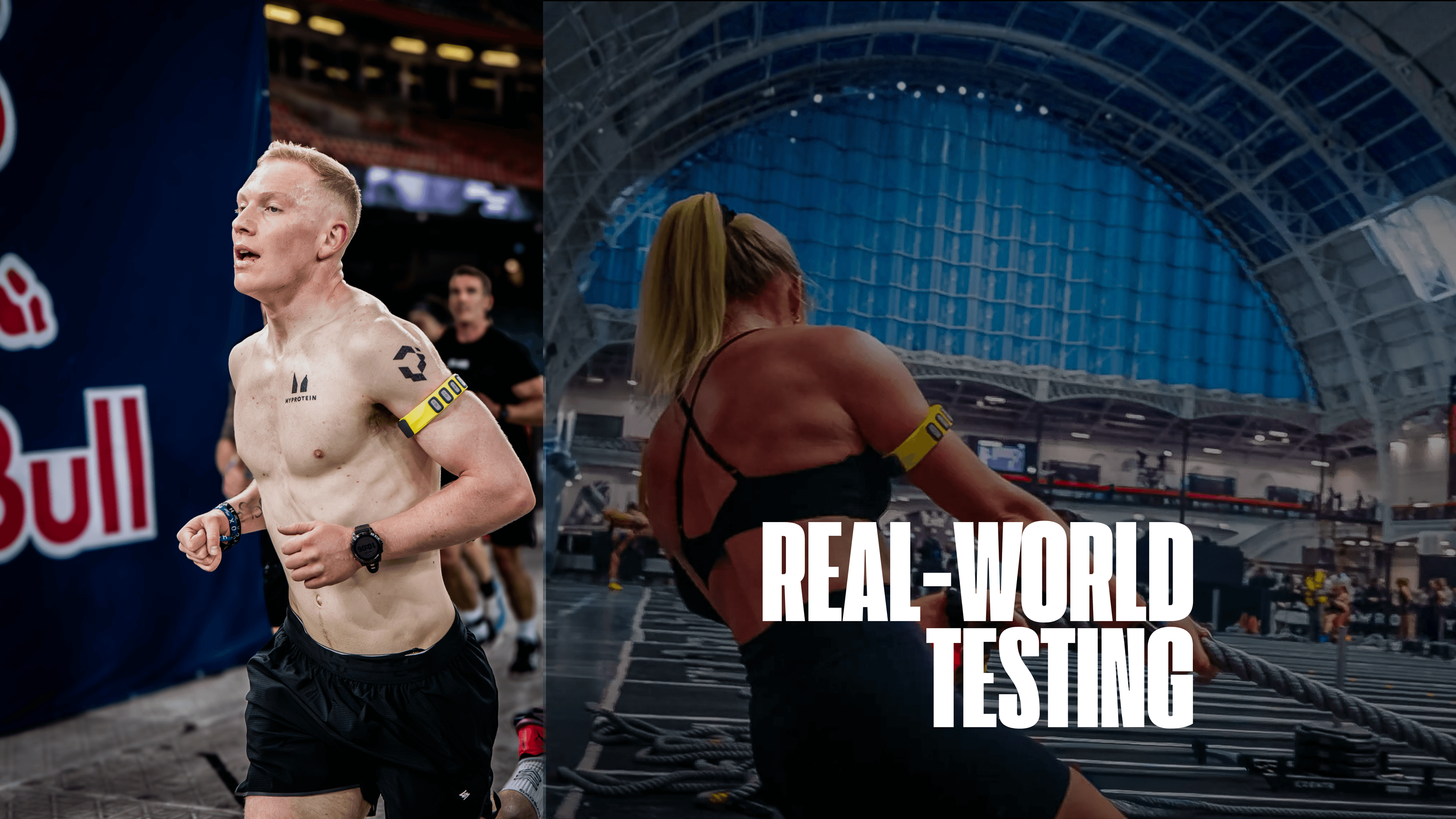
A wearable can look great on paper and still fall apart the moment it meets real sweat, real movement, and real intensity. That's why the latest phase of developing the new Performr band hasn't just been in a lab. It's happened on the floor of a Hyrox arena, on race courses, and across a whole range of sports, on the arms of people actually pushing their bodies hard.
Two priorities drove this round of testing: comfort and signal quality. Get either one wrong and the band fails at its core job. So we set out to prove the new design holds up where it matters most.
Why real-world testing is non-negotiable
Continuous, multi-analyte monitoring only works if two things are true at once. First, the band has to be comfortable enough that you genuinely forget you're wearing it, through hours of effort, not just a quick gym session. Second, it has to keep capturing clean, trustworthy signals even when you're drenched in sweat, gripping, dragging, lunging, and spiking your heart rate.
Those two demands are in tension. A band tight enough for a rock-solid signal can dig in and chafe; a band loose enough to feel like nothing can bounce around and introduce noise into the data. Threading that needle is the whole challenge, and you can only really test it under fire.
Liam at Hyrox
Hyrox is about as punishing a test environment as we could ask for: running mixed with sled pushes and pulls, burpees, rowing, wall balls, and farmers carries, a relentless blend of grip work, full-body movement, and sustained high heart rates.
Liam wore the new Performr band through a full Hyrox race, and putting it through an event that intense raised exactly the right questions. How should the band stay comfortable and secure through sled work and heavy carries? What do we really need from connection when someone is deep in competition, and which information actually matters most in those moments? Race conditions don't allow for do-overs, which is exactly why they're such valuable data. Watching how the band performed start to finish told us things no controlled trial could.
Louise across multiple sports
Alongside Liam's race, our cofounder and CSO, Louise, has been wearing the band across a much broader spread of activity, including her own race and a variety of different sports. That breadth matters as much as the intensity of any single event.
Different sports place completely different demands on a wearable. Arm position, impact, sweat, grip, and range of motion all vary enormously from one activity to the next, and each can affect both comfort and signal integrity in its own way. By testing across that range, Louise has been able to probe how consistently the band performs, not just in one discipline, but as an all-round device people can wear for whatever training their week throws at them. Having that perspective come from our own CSO means the scientific scrutiny is built right into the testing and development.
What we're learning
The combination, of competition and cross discipline testing, gives us both depth and breadth. We're learning exactly where the band excels, where comfort can still be refined, and how to keep the signals clean across the full spectrum of real human movement.
This is how a wearable earns trust: not by performing in ideal conditions, but by proving itself in messy, sweaty, unpredictable reality. Huge thanks to Liam, for putting the Performr band through its paces whilst in an important race. The data being generated is making the next version better with every session.