

The Truth About Lactate and Threshold
Lactate isn't a waste product. It's a fuel, a signal, and the key to understanding what threshold training actually does to your body.
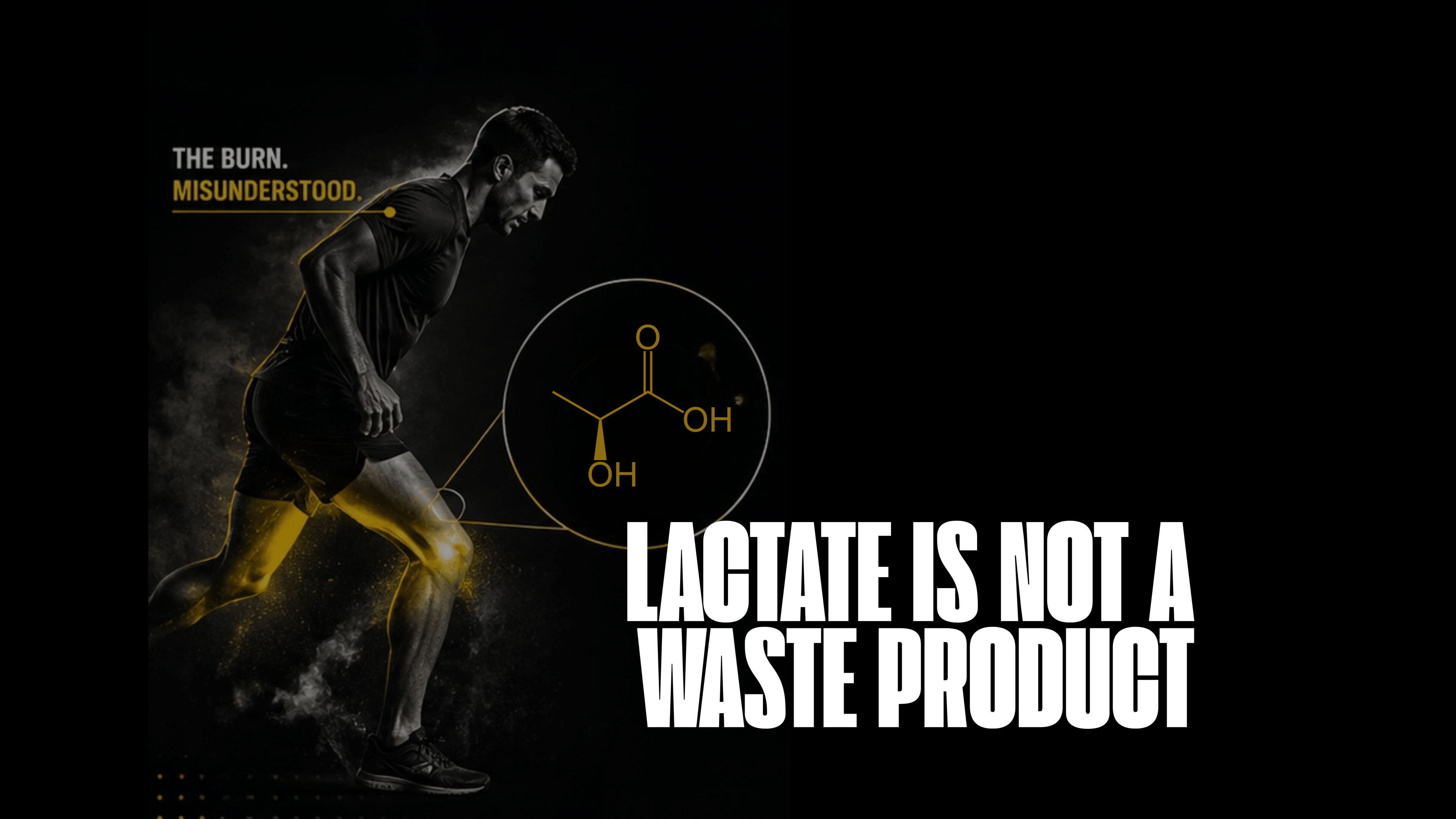
Lactate: The Misunderstood Molecule That's Changing How We Train
For decades, lactate has been the villain of endurance sport. Blamed for burning legs, dismissed as a waste product, and treated as something to push through or flush out, it became shorthand for suffering. If you've ever felt that searing fatigue in the final reps of a hard set, you've probably blamed lactate too.
But the science has moved on. And what researchers now understand about lactate is reshaping the way athletes think about training, fuelling, and recovery.
The Myth That Refuses to Die
The classic story goes like this: when you exercise hard, your muscles produce lactic acid. That acid builds up, makes your legs burn, and eventually forces you to stop. Lactate, in this telling, is metabolic exhaust — the smoke from a furnace working overtime.
It's a tidy explanation. It's also wrong.
The burn you feel during hard efforts isn't caused by lactate. It's primarily caused by hydrogen ion accumulation and other metabolic byproducts that lower the pH inside your muscle cells. Lactate itself is actually a buffer; it helps soak up some of that acidity rather than create it.
And it isn't waste. It's one of the most important fuels in your body.
What Lactate Actually Does
Modern exercise physiology, led by researchers like George Brooks at UC Berkeley, has rewritten the textbook on lactate. The current understanding is that lactate plays three critical roles:
1. It's a fuel. Lactate is a substrate your cells can burn for energy. Your muscles use it. Your heart uses it — in fact, the heart is one of the most enthusiastic consumers of lactate during exercise. Your brain uses it too, particularly under stress or during demanding cognitive work.
2. It's a signalling molecule. Lactate sends biochemical signals that influence gene expression, hormone release, and cellular adaptation. It plays a role in how your body responds and adapts to training.
3. It stimulates mitochondrial activity. Mitochondria are the engines inside your cells that produce ATP, the molecule that powers virtually every cellular process. Lactate helps drive this process forward, keeping the energy supply flowing during exercise.
Far from being a waste product, lactate is doing useful work all over your body, all the time.
You're Producing Lactate Right Now
One of the biggest shifts in understanding is recognising that lactate isn't only produced during hard exercise. Your body produces it constantly, at rest, during easy aerobic work, and during high-intensity efforts. The difference between those states isn't whether lactate is being made, but how much and how quickly it can be cleared and used.
This happens through what's known as the lactate shuttle. Lactate moves between cells (intercellular shuttling) and even within different compartments of the same cell (intracellular shuttling) to be used as fuel where it's needed most. Muscle cells produce it. Other muscle cells consume it. The heart pulls it from the bloodstream. The brain uses it during demanding tasks.
It's a continuous, dynamic process, not a one-way buildup of toxic exhaust.
So What Is Threshold?
If lactate is always being produced and always being used, what does "lactate threshold" actually mean?
Threshold is the point where production starts to outpace clearance. Up to a certain intensity, your body can use lactate as fast as you make it, keeping blood lactate relatively stable. Push past that point and the balance tips, lactate accumulates faster than your body can shuttle it back into the system as fuel.
This is the physiological inflection point that coaches talk about when they describe zone 2, zone 3, or threshold work. It's not a single number. It's a moving target shaped by your training status, fuelling, fatigue, and the type of exercise you're doing.
Threshold Training, Reframed
Here's where the new understanding really matters: threshold training isn't about teaching yourself to suffer through the burn. It's about training your body to handle lactate more efficiently; to produce it, transport it, and use it as fuel without falling behind.
That's the real adaptation. Trained athletes don't necessarily produce less lactate than untrained ones at the same workload. They clear and utilise it better. Their muscles, hearts, and metabolic machinery have learned to put it to work rather than let it accumulate.
This reframes what good training actually does:
Zone 2 work builds the mitochondrial density and enzymatic machinery that lets your body use lactate efficiently as fuel.
Threshold sessions push the ceiling of how much lactate you can use/clear at any given intensity.
High-intensity work challenges and refines the entire system under stress.
The goal isn't to avoid lactate. It's to get better at handling it.
Why This Matters for How You Measure Training
For most athletes, lactate has historically been measured the hard way: a finger or earlobe prick, a drop of blood, a handheld meter, often mid-session in awkward conditions. It works, but it gives you a snapshot, not a story. You can take a few readings during a structured test, but you can't see how your lactate behaves across an entire session, across different efforts, or across the changes that happen as you fatigue.
That's the gap continuous lactate monitoring is built to fill. Instead of one or two data points, imagine a continuous curve seeing exactly where your threshold sits today, how lactate responds to different paces, and whether you're actually training in the zone you intended to.
This is what we're building at Performr: a wearable biosensor that tracks lactate continuously, so athletes can train with the precision the science now demands. Because if threshold training is really about teaching your body to use lactate efficiently, you need to be able to see what your body is doing in real time — not guess at it between finger pricks.
The Takeaway
Lactate isn't the enemy. It isn't waste. It isn't even what makes your legs burn.
It's fuel. It's a signal. It's a constant, vital part of how your body produces energy: at rest, during easy training, and at the edge of your capacity. Understanding that changes how you think about every session you do, and what you're really training when you're training "at threshold."
The athletes who get the most out of training in the coming years won't be the ones who can suffer the longest. They'll be the ones who understand their physiology best and have the tools to measure it.
Performr is developing continuous lactate monitoring for athletes who want to train smarter, not just harder. Sign up to the waitlist for more information and to keep up to date with the latest developments.